
In practical use of internal combustion engines, it has long been observed that when an internal combustion engine reaches a certain rotational speed, its operation becomes obviously uneven, accompanied by mechanical knocking and vibration, and its performance deteriorates. If this continues for a long time, the crankshaft may fracture. Raising or lowering the rotational speed can alleviate or even eliminate the knocking and vibration. This shows that these phenomena are not caused by the engine’s inherent unbalance; otherwise, the vibration should increase dramatically with the rotational speed, since the unbalanced inertial force is proportional to the square of the rotational speed. Extensive theoretical and experimental research has proven that this phenomenon is mainly caused by large-scale torsional vibration of the crankshaft: due to insufficient torsional stiffness of the shaft system, under the action of a single-throw torque that varies with time, a considerable periodic relative torsion occurs between the adjacent crank throws. The more cylinders and the longer the crankshaft, the more severe this phenomenon becomes—this is the torsional vibration of the crankshaft.
When the shaft system reaches a certain rotational speed, the periodically changing torque applied to the crankshaft will resonate with the crankshaft’s own vibration frequency. When resonance occurs, the crankshaft’s torsional deformation will far exceed normal values, potentially causing significant noise and increased wear, or even crankshaft fracture. Therefore, when designing an internal combustion engine, it is essential to calculate and analyze the torsional vibration characteristics of the shaft system to determine its critical rotational speed, vibration mode, amplitude, torsional stress, and whether vibration reduction measures are necessary.
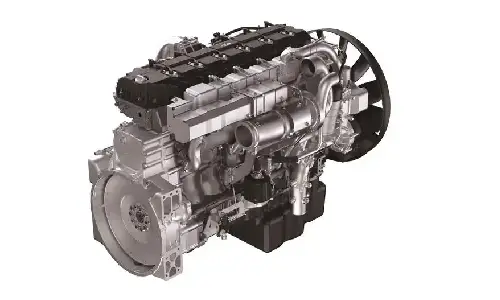
1. Definition of torsional vibration
Torsional vibration refers to periodic mutual torsion between different crankshaft sections.
2. Torsional vibration phenomenon
1). If the engine vibrates violently at a certain speed, noise, wear, and fuel consumption will increase, power will decrease, and in severe cases, the crankshaft may fracture.
2).When the engine deviates from this rotational speed, the above phenomenon disappears.
3. Causes of torsional vibration
1).The crankshaft system is composed of materials with a certain degree of elasticity and inertia, and it inherently possesses a certain natural frequency. (Internal factor)
2).The system is acted upon by periodically varying excitation torque in magnitude and direction. (external factors)
Periodic changes in gas pressure:
This is the primary excitation source for crankshaft torsional vibration in internal combustion engines. During engine operation, the combustion gases in the cylinders generate periodic bursts of pressure during the compression and power strokes. This pressure is transmitted through the piston and connecting rod to the crankshaft cranks, forming a periodically varying tangential force, which is then converted into torque driving the crankshaft to rotate. Due to the phase difference between the working cycles of each cylinder (intake, compression, power, and exhaust), and the fact that the combustion gas pressure during the power stroke is much higher than in other strokes, the total torque acting on the crankshaft exhibits significant periodic fluctuations, continuously exciting the crankshaft to produce torsional vibration. For example, in one working cycle of a four-stroke internal combustion engine, only the power stroke generates positive driving force, while other strokes consume power. This alternation of torque peaks and troughs directly triggers torsional vibration of the crankshaft.
Alternating action of reciprocating inertial force and rotational inertial force
When an internal combustion engine is running, components such as the piston and connecting rod reciprocate, generating periodically varying reciprocating inertial forces. The crankshaft itself, with its cranks, counterweights, and other components, rotates, generating centrifugal inertial forces. These inertial forces are transmitted to the crankshaft through the connecting rods and cranks, creating alternating additional torque, which becomes a secondary excitation source for torsional vibration. Especially in multi-cylinder internal combustion engines, the inertial forces of each cylinder are superimposed. If the superimposed inertial force exhibits periodic fluctuations, it will further exacerbate the torsional vibration of the crankshaft.
Disturbance of external transmission load
The crankshaft’s output end needs to drive accessories such as the gearbox, generator, and water pump. The operation of these accessories will generate reverse load disturbances on the crankshaft. At the same time, the meshing clearance and belt tension changes in gear and belt drives will also generate periodic excitations that are transmitted to the crankshaft, inducing or aggravating torsional vibration. In addition, if there are clearances at the connection points between the crankshaft and the flywheel or clutch, it will also lead to uneven torque transmission, further amplifying torsional vibration.
3) When the frequency of the excitation torque coincides with the system’s natural frequency, the system will resonate.
4. The purpose of studying torsional vibration
Design phase: Calculate the critical speed, amplitude, and torsional stress to determine whether to take vibration reduction measures or avoid the critical speed.
Completion stage: The resonance, amplitude, and vibration properties of the engine are measured through experiments.
5. Composition of the torsional vibration equivalent system
According to the principle of dynamic equivalence, the equivalent moment of inertia is arranged where the actual shaft has lumped mass; the stiffness of the equivalent shaft segment is equivalent to that of the actual shaft segment, but it has no mass.
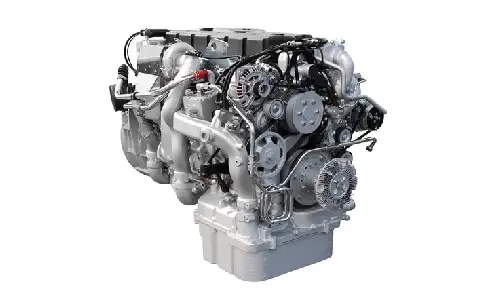
6. Core characteristic parameters of crankshaft torsional vibration
To accurately describe and analyze crankshaft torsional vibration, it is necessary to master its core characteristic parameters. These parameters are also key to subsequent torsional vibration analysis, optimization, and troubleshooting. Using the mm-t-s unit system commonly used in engineering, the specific parameters are as follows:
Angle of twist (unit: rad/deg)
Torsional angle is a core parameter for measuring torsional vibration amplitude. It refers to the maximum torsional angle of a certain shaft segment relative to a fixed shaft segment during torsional vibration. The larger the torsional angle, the more severe the torsional vibration and the more obvious the torsional deformation of the crankshaft. In engineering, torsional vibration tests or simulation analysis are usually used to obtain the torsional angle of key parts of the crankshaft (such as the main journal and crank web) to determine whether the torsional vibration exceeds the standard.
Torsional stiffness (unit: N·mm/rad)
Torsional stiffness is the crankshaft’s ability to resist torsional deformation and is one of the core factors affecting torsional vibration frequency. The greater the stiffness, the smaller the torsional deformation of the crankshaft under the same excitation torque, and the smaller the torsional vibration amplitude; conversely, the smaller the stiffness, the easier it is to induce torsional vibration. The torsional stiffness of a crankshaft is closely related to its material (such as Q235 or 45 steel), geometric dimensions (shaft diameter, crank web thickness), and structural form (full-support or non-full-support structure), and is a key parameter to optimize during crankshaft design.
Damping (dimensionless)
Damping is a key factor in attenuating torsional vibration. It refers to the crankshaft’s ability to dissipate vibrational energy and gradually reduce the amplitude of torsional vibration during the torsional vibration process through internal material friction, bearing friction, and lubricating oil damping. Greater damping results in faster torsional vibration attenuation and a lower likelihood of resonance; conversely, smaller damping leads to a longer torsional vibration duration and a higher risk of resonance. In engineering, torsional vibration dampers are typically installed to increase the damping of the crankshaft system and suppress torsional vibration.
Natural frequency (unit: Hz)
The natural frequency is an inherent property of the crankshaft system. It refers to the frequency at which the crankshaft undergoes free torsional vibration when there is no external excitation. It is only related to the mass distribution (moment of inertia) and torsional stiffness of the crankshaft, and is independent of the excitation load. Because the crankshaft is relatively long, has low torsional stiffness, and has a large moment of inertia of components such as the flywheel, its natural frequency is usually low and tends to fall within the operating speed range of the internal combustion engine. This is the core reason why the crankshaft is prone to resonance.
Mode shape
A mode shape refers to the vibration pattern of different parts of a crankshaft during torsional vibration, that is, the distribution pattern of torsional angles in different shaft segments. Crankshaft torsional vibration modes are divided into multiple orders. The first-order mode shape represents the overall torsional oscillation of the crankshaft, while higher-order modes exhibit relative torsion between shaft segments (such as the opposite torsional motion of adjacent crank web). Different orders of mode shapes correspond to different natural frequencies. In engineering, analyzing mode shapes can determine the stress concentration points of the crankshaft, providing a basis for structural optimization.
Classification of crankshaft torsional vibration
Based on the different excitation sources, crankshaft torsional vibrations can be divided into two main categories. The characteristics, generation mechanisms, and effects of these two categories differ significantly, which is an important basis for the classification of torsional vibration analysis.
Free torsional vibration (natural torsional vibration)
Free torsional vibration refers to the torsional vibration of a crankshaft caused solely by an initial disturbance (such as a starting impact or sudden load change) without any continuous external excitation. Its vibration frequency is equal to the crankshaft’s natural frequency, and due to damping, the vibration amplitude gradually decays and eventually disappears. Free torsional vibration typically lasts for a short period in engineering applications and has a relatively small impact on internal combustion engines. However, if the initial disturbance is too large, it can lead to localized stress concentration in the crankshaft, causing damage.
Forced torsional vibration
Forced torsional vibration refers to the torsional vibration generated in the crankshaft under the continuous action of a periodic external excitation load (such as gas pressure or inertial force). It is the most common and significant type of torsional vibration during the operation of an internal combustion engine. Its vibration frequency is consistent with the periodic variation frequency of the excitation load and does not decay over time; as long as the excitation load exists, the torsional vibration will persist. When the frequency of the excitation load is the same as or an integer multiple of the crankshaft’s natural frequency, the torsional vibration amplitude will amplify dramatically. This phenomenon is called “resonance” and is one of the main causes of crankshaft failure.
The core difference between crankshaft torsional vibration and bending vibration
During operation, the crankshaft of an internal combustion engine generates not only torsional vibration but also bending and axial vibration. Bending and torsional vibrations are the most common, and their core differences lie in four main aspects, which are also key to distinguishing between the two types of vibration and troubleshooting in engineering:
Different vibration directions
Torsional vibration is circumferential, meaning it involves twisting back and forth around the crankshaft’s own axis without radial or axial displacement. Bending vibration, on the other hand, is radial/axial, meaning the crankshaft bends and oscillates in a direction perpendicular to its own axis, manifesting as radial runout or axial movement of the journals. Simply put, torsional vibration is “torsional,” and bending vibration is “bending oscillation.”
Different types of forces
Torsional vibration is essentially caused by alternating torsional stress on the crankshaft bearing, with the stress mainly concentrated in the main journals, crank web, and crank pins—areas bearing torque. Bending vibration, on the other hand, is caused by alternating bending stress on the crankshaft bearing, with the stress mainly concentrated in the journals and transition fillets of the crank web. These two types of stress act in different ways, leading to different types of crankshaft damage—torsional vibration easily leads to crankshaft fatigue fracture, while bending vibration easily leads to journal wear and crank web cracks.
Different affected areas
Torsional vibration mainly affects parts related to torque transmission, such as the crankshaft main journal, crank web, flywheel, and clutch. In severe cases, it can affect the operational stability of accessories. Bending vibration mainly affects parts related to radial loads, such as the crankshaft journal, connecting rod, and bearings. In severe cases, it can lead to bearing overheating, accelerated wear, and even connecting rod deformation.
Different excitation sources
The main excitation source of torsional vibration is periodically changing torque (gas pressure, inertial force); the main excitation sources of bending vibration are the unbalanced mass of the crankshaft, radial inertial force, and radial load fluctuations in the bearings. Furthermore, the natural frequency of bending vibration is usually higher and less likely to fall within the operating speed range of an internal combustion engine, while the natural frequency of torsional vibration is lower, making it more prone to resonance and causing more significant damage to the internal combustion engine.


